

Chat & Ask (⌘K / Ctrl+K)
Once AI is set up, Graphium gives you two ways to talk to a model without leaving your work: a chat panel that knows what note (or block) you are looking at, and the Composer — a ⌘K (Ctrl+K on Windows/Linux) palette that combines note search with one-shot AI questions. This page covers both, plus how answers cite sources, how to reuse an answer, and how to steer the AI with skills.
Which model answers
Chat and the Composer answer with the Chat model if you picked one in the Chat group under Settings → AI. Left empty, they use the Light work model under Model assignment, and only when Research before answering is on (see below) do they use the Advanced work model instead. See AI setup.
The AI chat panel
Open the Chat tab in the right-side panel of a note (the robot icon). The tab appears once an AI model is registered. Type a question and press ⌘Enter (Ctrl+Enter on Windows/Linux) to send; a Stop button cancels an in-flight answer.
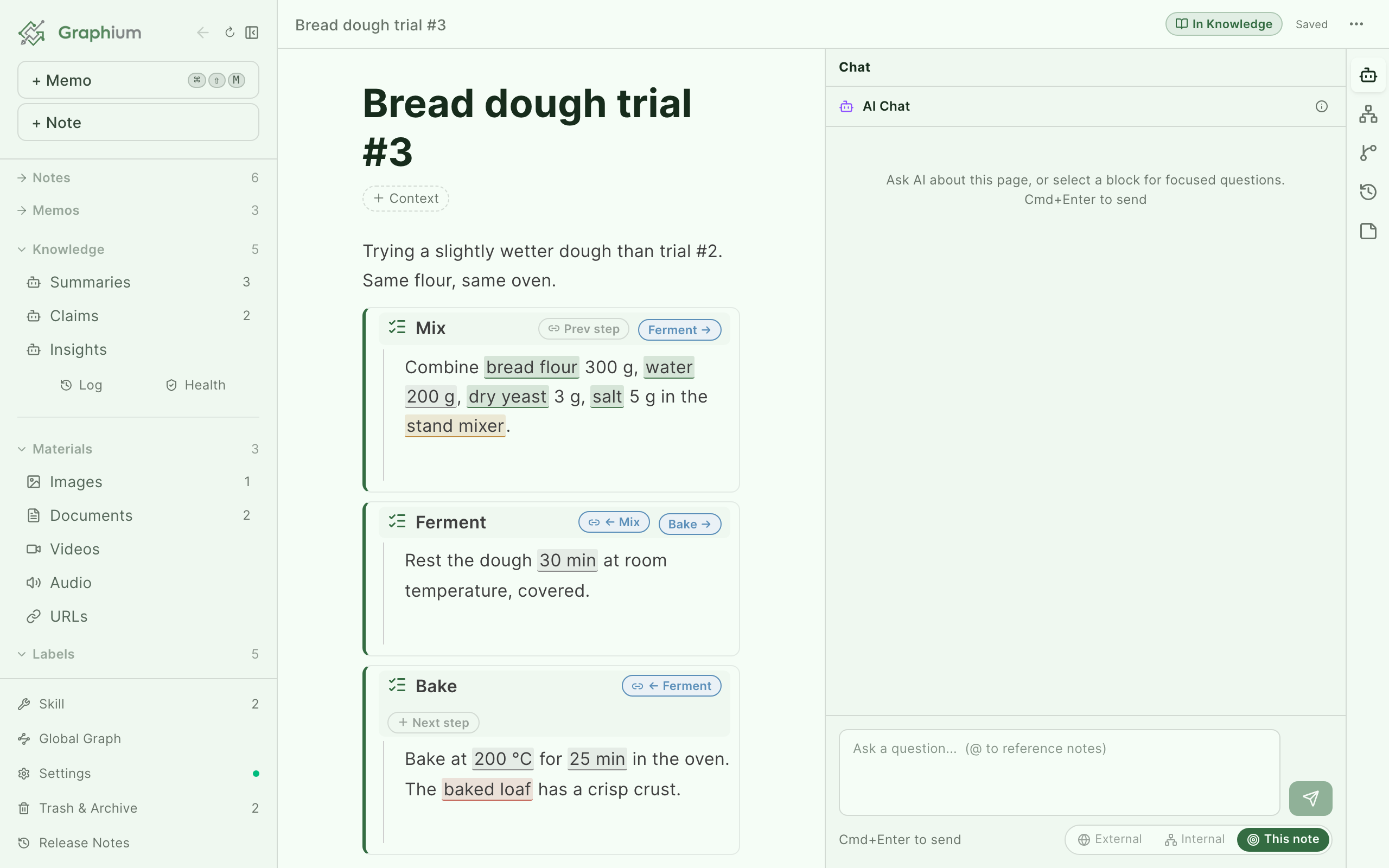
By default the chat can see the note you have open. To focus it on a specific part of the note instead, start the chat from the editor:
| Starting point | What the conversation is about |
|---|---|
| Chat tab | The whole current note |
| Drag handle (⠿) → 🤖 AI Assistant | That block — for a heading or a step block, everything under it is included as one unit |
| Select multiple blocks → Ask AI about selection | Exactly the blocks you selected |
| Select text → Ask AI about selection in the floating toolbar | The selected text |
Whichever starting point you use, the note you have open is passed as background as well. A quoted sentence that leans on the lines before it — a pronoun, an abbreviation, "under these conditions" — is still understood. The answer stays on the quoted part; the rest of the note is there only for context. It is re-read on every message, so edits you make mid-conversation are picked up. Added in v0.29.0 (2026-08-05)
When a chat starts from blocks or a selection, the passed content stays visible at the top of the panel under Quote, so you always know what the conversation is about.
Referencing notes and materials with @
Type @ in the chat input to search your notes and knowledge pages and attach one as context — the input hints at this with "(@ to reference notes)". Attached items appear as chips above the input and are sent with your next message.
If the attached note was created from a PDF, web page, or Word document, Graphium prioritizes what you distilled from it — your memos and derived knowledge — and falls back to the original text, so the AI answers from your reading rather than a cold document.
Materials have their own chats too: open a material in full view and use Ask AI in its right panel to chat about that PDF or web page directly. These conversations are saved per material and are there when you come back.
Adding images to a message Added in v0.111.0 (2026-11-03)
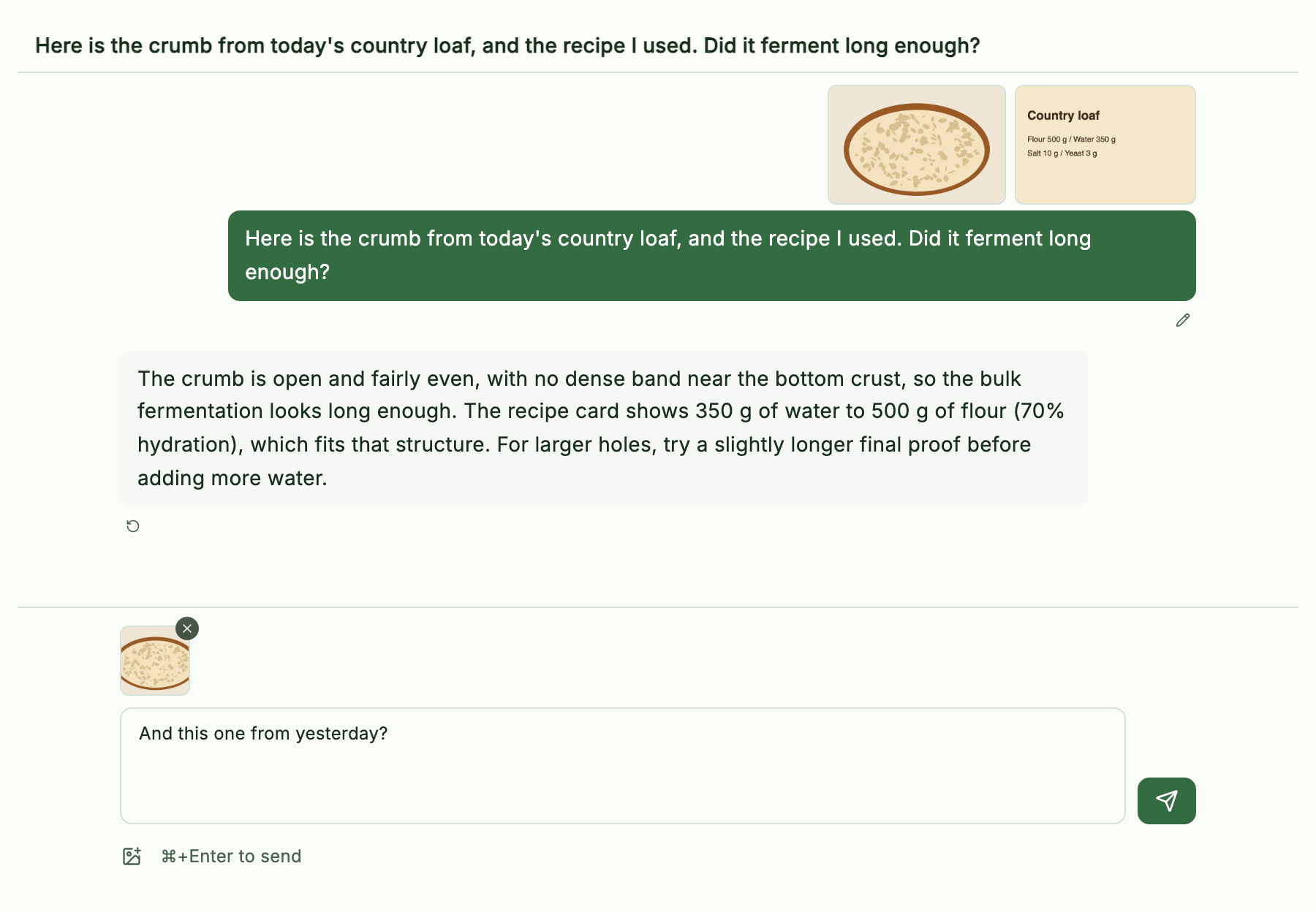
To ask about a photo, a screenshot or a page you took a picture of, add the image to your message. Use the Add images button at the left of the line under the input, paste an image with ⌘V (Ctrl+V), or drop image files onto the input. This works in a note's chat panel and in Chat without a note open. One message can carry up to 4 images; click × on a thumbnail to take one off before you send.
- Each image is shrunk on your device before it is sent (the long edge to 1568 px, as a JPEG). Location and other details a camera stores in a photo are dropped.
- The image is saved with the conversation, not as a material, so it does not appear in the materials gallery. Click a picture in a sent message to see it larger. If the image is not stored on the device you are using, a placeholder is shown in its place.
- When you edit and resend a message, or regenerate its answer, its images are sent again. Later messages in the same conversation send the earlier images as well — the 8 most recent.
- If the AI model you use cannot see images, a line above the input says so: This AI can't see images. The text in them will be read on this device and sent instead. Graphium reads the text in each image on your device (OCR) and sends that text. A photo with no text in it then reaches the AI only as a note that no text could be read.
- An image that an answer links from another site is not loaded on its own. The answer shows a small box with the site it would come from and a Load image button, and the picture is fetched only when you press it. Loading it tells that site your IP address. An image in an answer never sends a request to another site until you press the button.
Models treated as able to see images: Anthropic, Google, GitHub Copilot, OpenAI (except gpt-3.5, o1-mini, o3-mini and gpt-oss), and OpenAI-compatible servers (LM Studio, Ollama and the like) whose model name marks a vision model — for example one containing vl, vision, llava, pixtral, gemma-3 or llama-4.
Choosing what grounds the answer Added in v0.16.8 (2026-07-02)
The Grounding chip next to the input controls what evidence the AI draws on. The same chip appears in the Composer.
| Scope | Behavior |
|---|---|
| External | "Search the web and ground the answer in external sources — for investigating something new" |
| Internal | "Everything you cited, plus a cross-search of your accumulated knowledge — for ideation" |
| This note | "Only what this note cites, without a cross-search — for accurate writing and citations" |
This note is the default: answers stay pinned to what you explicitly cited, which is what you want while writing.
What the cross-search in Internal (and External) reads: your knowledge pages first, and a few short passages from your own notes and assets — image text read by OCR, URL excerpts, PDF and Word text — that share words with your question. Those passages come from a full-text index kept on this device (see Settings → Storage, inside the collapsed Advanced group); no embedding model is needed, and it works offline. The AI is told which passages are raw material rather than distilled knowledge, so it can say so when an answer rests on a note rather than on a knowledge page. Which type of knowledge page the cross-search brings depends on which pages the words of your question overlap with. In my measurement, a question with a topic's name in it brought that topic, and a sentence stating one fact brought claims (what I measured). Whole notes still enter a conversation the way they always have: cite them with @. Added in v0.39.0 (2026-08-17) On desktop, if a shared folder is configured, its entries are cross-searched the same way unless you turn that off in Settings → Sharing. Added in v0.52.0 (2026-09-03)
Letting the AI research before answering Added in v0.93.0 (2026-10-21)
The cross-search above runs once, with your question, before the AI starts. If you turn on Research before answering in Settings → AI → Chat (off by default), chat replies use the Chat model if you picked one, otherwise the Advanced work model from Model assignment (stronger models gain more from it), and the AI also gets read-only tools in Internal and External chats, and in chats without a note open. Two of them look things up by words and meaning:
- Search again — the same search as the first one (same index, same ranking), but with words the AI picks. It helps when your wording and the note's wording differ.
- Read a whole page — opens a note or knowledge page that came up in a search, up to 6,000 characters, when a short passage leaves out the conditions or numbers.
- Find notes that used something — the notes where you labeled a given material, tool, condition or output (for example an atmosphere such as
Ar, or an instrument). Short names match as whole words, soArdoesn't match "parameter". - Read the steps — a note's steps in order, each with the materials, tools, conditions and outputs labeled in it.
- Trace the lineage — what a note was built from (earlier notes, samples, the PDF or web page it came from) and what was built from it. Notes linked only with an
@mention come back as connections with no direction, so the AI judges which came first from the notes themselves instead of reading the link as "built from". - List the labels — which materials, tools, conditions and outputs are labeled across your notes, for when the AI doesn't know which name to look for.
These answer questions a word search handles poorly, such as "which runs used this furnace, and at what temperature?" — the AI finds the runs by the label, then reads their steps. What the AI finds this way is numbered and cited the same way as the first search, so the links in the answer open the same pages; when a note shares its title with a knowledge page (a summary is titled like the note it summarizes), the link reads "… (note)" and opens the note. The AI is asked to use the tools only when the first search isn't enough, and to stop at about five calls per question; even so, replies take longer and use more of your AI quota. This note chats never get the tools — they stay limited to what you cited.
Added in v0.116.0 (2026-11-04) While the AI works, the "Thinking…" line lists each lookup as it finishes ("Looked for a material, tool, or condition: Ar — 2 found"). Under the answer, How the AI looked it up keeps the same list, collapsed, so you can check later which notes the answer rests on.Things to know before turning it on:
- It is slower and costs more. Every tool call is one more round trip to the model, with the whole conversation sent again, so a question that uses two tools can take two to three times as long.
- How well it works depends on the model. Capable models use the tools well; smaller models, or models that call tools through plain text (such as gpt-oss on some endpoints), may skip them, repeat the same search, or stop searching too early.
- The same question can take a different path. Which words the AI searches with can change from one try to the next, so answers vary a little more than with the single search.
- It doesn't make a search exhaustive. With about five calls per question, "list every note that…" questions still won't reach everything. The structural tools only see what you labeled and linked — an unlabeled mention of a material is left to the word search.
- Keep Graphium open while it answers. The tools run in the app itself, so if you close it mid-answer, the remaining searches are skipped after 30 seconds and the AI answers from what it already has.
How much it helps, and with which models, is measured in Research before answering: does it help?. How the tools that follow structure handle step and lineage questions is in Provenance tools: do they answer step and lineage questions?.
Web search in chat Added in v0.16.6 (2026-06-30)
Choosing External forces a web search. To give Graphium one, register a search MCP server (such as Tavily) in Settings → AI, inside the collapsed Connect external tools (MCP) group.
So you can tell where a statement comes from, sources at the end of an answer are labeled 📓 From your notes for internal citations and 🌐 Web sources for pages found on the web. Clicking an internal citation opens what it points at — a knowledge page or a note in the side peek, or an asset in the material peek.
When no web search is configured
If you select External without a search MCP server, a dismissable banner appears above the input: "No web search is set up — External will answer without live web results. Add a search MCP server (e.g. Tavily)," with an Open settings shortcut. The question still runs — the answer just cannot include live web results.
Editing, regenerating, and forking Added in v0.16.10 (2026-07-03)
Conversations are editable, not append-only:
| Action | Where | What it does |
|---|---|---|
| Edit and resend | Pencil icon under your own message | Rewrite the message and press Resend. As the note warns, "Resending replaces the conversation after this message." Attached notes are re-attached automatically. |
| Regenerate response | Circular-arrow icon under an AI reply | Asks the model to answer the same question again. |
| New chat from here | Fork icon under an AI reply | Starts a new chat carrying the conversation up to that reply, leaving the original intact. Forked chats show a Forked badge in the history list. |
Chat without a note open Added in v0.81.0 (2026-09-18)
The Chat tab of the left nav — next to Notes, Knowledge and Materials — holds conversations that are not about any particular note. It lists your chats; pick one (or + New chat) and the content area becomes the conversation, the way ChatGPT or Claude lays one out. The breadcrumb reads Home → Chat, and opening the chat screen switches the left nav to the Chat tab. On a wide window (1280px or more) the graph sits beside the conversation. Added in v0.95.7 (2026-10-26)
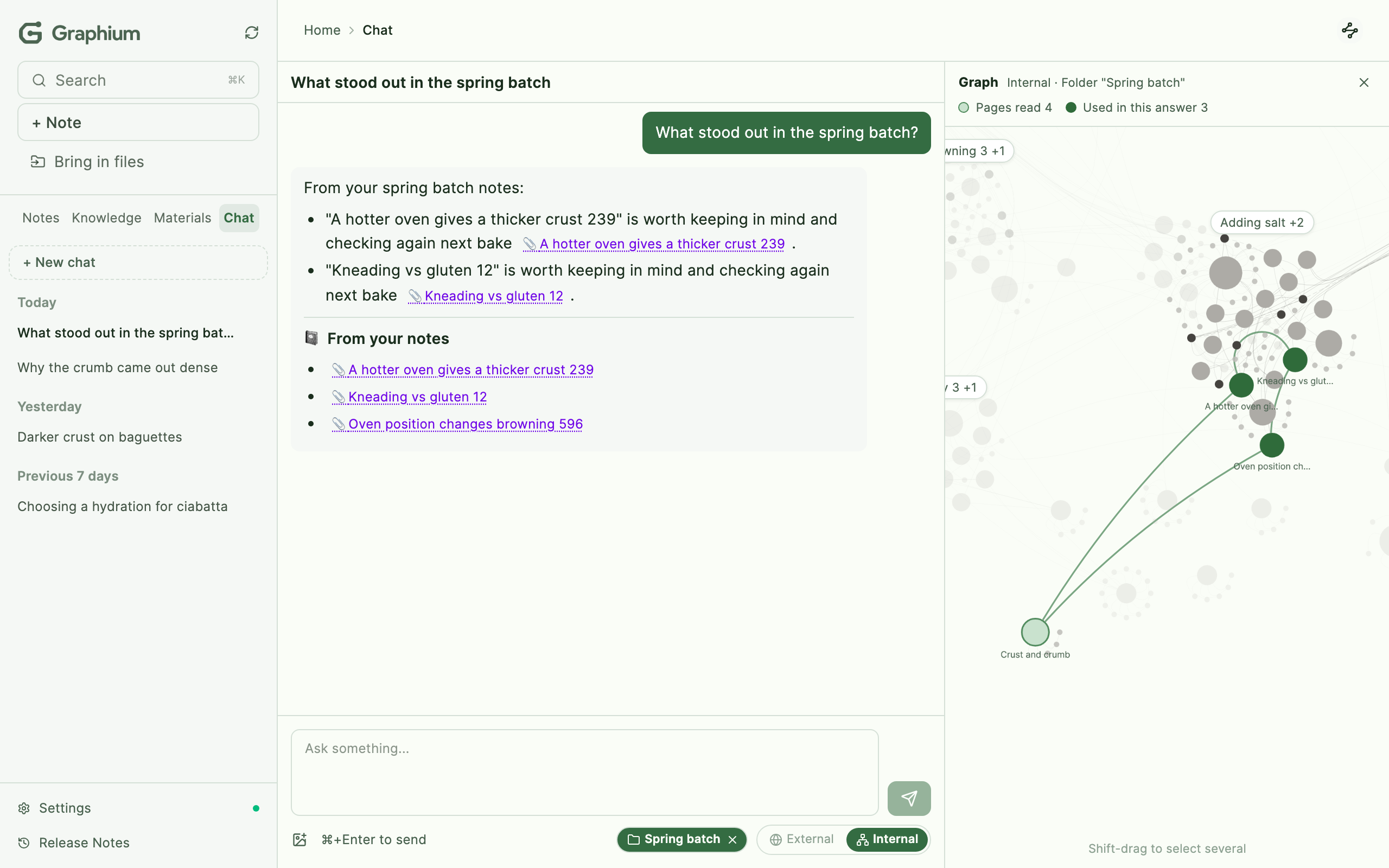
The chat list starts with + New chat, then your past conversations grouped by when they were last updated — Today, Yesterday, Previous 7 days, Older. Each row shows the title the AI writes once the first exchange is done; until then it shows the first question. Hovering a row reveals a delete button, which asks for confirmation. When the left nav is collapsed, or on a narrow window, the list moves into the chat screen itself; on a narrow window the list and the conversation take turns, with a back button to return.
With nothing selected the right side is a new chat: a prompt reading "Ask something to get started" with the input and the Grounding chip in the middle of the screen. Your first message creates the conversation, adds it to the list, and moves the input to the bottom, where it stays for the rest of the exchange. ⌘K and Ask in chat on a "Worth investigating" row in Upkeep's Upkeep tab start a new conversation on this screen the same way, with the question already sent.
It always cross-searches your notes and Knowledge, so the Grounding chip next to the input has two settings rather than three: Internal (the default — your notes and Knowledge) and External (the same, plus a forced web search; see Web search in chat for what External needs and the banner you see without it). There is no This note here, since no note is attached. The scope you pick stays with that conversation — later messages use it, it is selected again when you reopen the chat, and a fork inherits it. A question sent from ⌘K keeps the scope chosen on the Composer; This note chosen there behaves as Internal.
Conversations support edit and resend, regenerate response, and new chat from here (forking), with the same look and controls as the note chat panel. Forking is the one difference: instead of adding to the same note's history, it adds a new conversation to the list. What is still missing: @ attachments, Make Knowledge (the claims/insights picker), and inserting or replacing into a note — there is nothing to insert into, since it is not attached to a document, but Keep as knowledge is available to save the answer as its own page.
A conversation is saved the moment you send a message, not when the answer comes back — so if the AI request fails, the question stays in the list and you can reopen it later. While waiting for a reply the panel shows "Thinking..." with a Stop button that only cancels the conversation you are looking at; other conversations keep running if you switch away. Deleting the conversation you have open returns you to a new chat.
Conversations live on this device, in app data — never mixed into a note file, so they do not travel with a note if you export or share it.
Seeing what the AI read and used
On a wide window the chat screen shows your Global Graph beside the conversation, so you can see where the AI went for each answer. The button at the right end of the header shows or hides it, and Graphium remembers your choice. The graph itself does not move while you talk; only the pages the AI touches change. Only those pages show their titles — hover over any other point to see its title.
| What you see | What it means |
|---|---|
| Dark green, large | A page the latest answer cited |
| Mid green | A page an earlier answer in this conversation cited |
| Pale green with a rim | A page the AI read — in the context it was given, or with its tools when it searches again — but did not cite |
| Green line | A link between two pages the AI touched — how its sources connect. Claims that came from the same record are joined through that record, even though the AI didn't open it; its title stays visible |
| Thick dark green line | A link the AI actually followed with its provenance tools when it searches again (for example from a record to the record it was built from); the header counts them (Links followed) |
| Grey | A page the AI did not touch |
While you wait for an answer, each page lights up once as the AI reads it, and the header counts them ("Reading 8"). When the answer arrives, a line between two pages the AI touched — both read or cited — turns green and stays, so you can see how the sources connect (for example a claim and the record it came from). Sparks run once along those green lines, starting from the cited pages, then stop; nothing lights up elsewhere. The links are easiest to see when you zoom in around the lit pages. The header then shows Pages read and Used in this answer, plus Web sources for an External answer.
The graph also shows the scope you set. The header names it (for example Internal · Folder "Spring batch"), and when a Folder to search is chosen, pages outside it fade. Pages you attached with @ get a purple ring. If the latest answer ever read or cited a page outside the folder it was asked in, that page gets a red dashed ring and the header counts it — this should not happen, so it tells you the scope was not kept. The colours stay when you reopen the conversation, because each answer keeps the list of pages it read. Clicking a page opens it in the side peek without leaving the chat.
| Note chat panel | Chat without a note | |
|---|---|---|
| What it is about | The note (or block) you have open | Nothing in particular — its own topic |
| Insert / replace into a note | Yes | No |
@ attachments | Yes | No |
| Grounding chip | External / Internal / This note | External / Internal (always cross-searches, so no This note) |
| Folder to search chip | No | Yes |
| Edit / regenerate / fork | Yes | Yes (forking adds a new conversation to the list) |
| Make Knowledge (claims/insights picker) | Yes | No (Keep as knowledge is available) |
| What Stop cancels | That conversation | Only the conversation you are looking at (others keep running if you switch away) |
Use the note chat panel while you are writing and want the AI to see (or write into) that note. Use the sidebar chat when the question is not about any one note — general questions, working things out, or checking something across everything you have written.
⌘K is another way in: press it from anywhere, including with a note open, and choose Ask AI: "..." (or ⌘Enter) to start one of these note-independent conversations without leaving where you are. See The Composer below.
Chats stay with the note — and keep running Added in v0.17.1 (2026-07-06)
Each note keeps its own chat history, saved with the note. In the panel header, Chat history lists past conversations (with message counts), + New chat starts a fresh one, and Clear chat discards the current one.
Switching notes does not kill a running answer. The request keeps going in the background, the result is written back to the correct note's chat, and when you return to that note the Chat tab reopens on the conversation.
Asking about a shared note Added in v0.59.0 (2026-09-07)
Entries in the shared folder can be discussed the same way, without forking them first. Open one in full view (double-click its row, or Open in full view in the detail panel) and pick Ask AI from the right-hand rail. The tab is there once an AI model is set up, and for entries that have something to read — not for files shared as materials, or for comments.
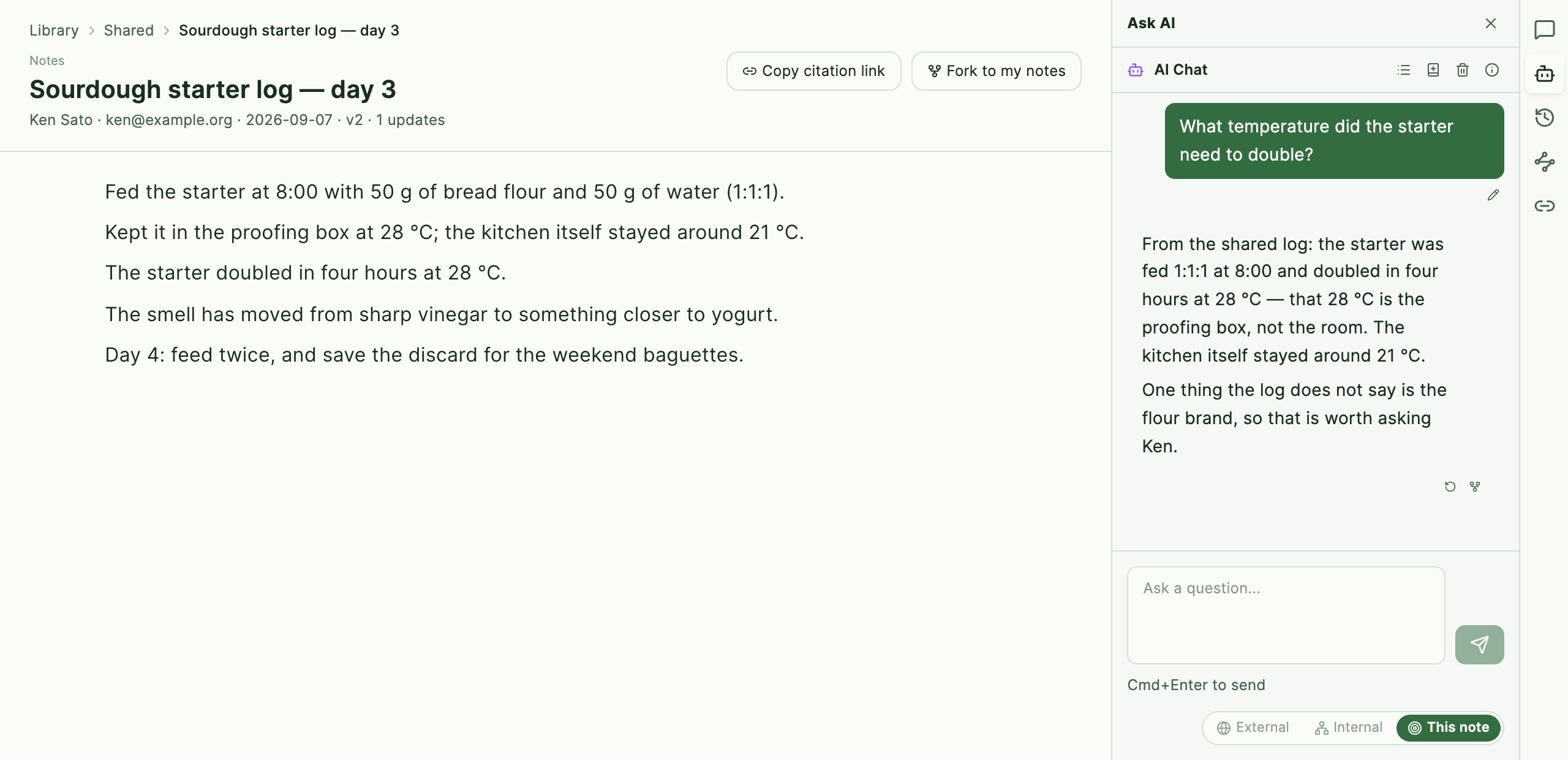
Three things are worth knowing about it:
- Click a paragraph to ask about that paragraph. While Ask AI is the open tab, clicking a paragraph in the body starts a new conversation quoting it, instead of marking it as the place for a comment. Close the tab, or switch back to Comments, and paragraph clicks go back to picking a comment target.
- The conversation stays on your side. Questions and answers are saved on your own device, never in the shared folder — the person who shared the entry does not see that you asked, or what you asked. Nothing is written into provenance either, so the buttons under an answer — Insert into note, Derive as note, Make Knowledge, Keep as knowledge — are not offered here; it is someone else's material you are reading, not your own note you are writing. To keep something from the conversation, use Add to Knowledge in the panel header (the book icon, which appears once the conversation has a message): it hands the whole conversation to your own Knowledge layer and reports what it wrote in a toast.
- The shared text is what grounds the answer. The entry's content travels with every question (long entries are cut off, with a line saying so), so the model answers from what is actually shared rather than from the title. Whether the answer may also draw on other shared entries follows the search setting described in Storage & sync; your own notes and Knowledge are reached the usual way, by choosing Internal or External as the grounding scope.
One limitation to keep in mind: leaving the page cancels an answer still being written. Unlike a note's chat, this conversation does not keep running in the background — wait for the reply before you navigate away.
Using an answer
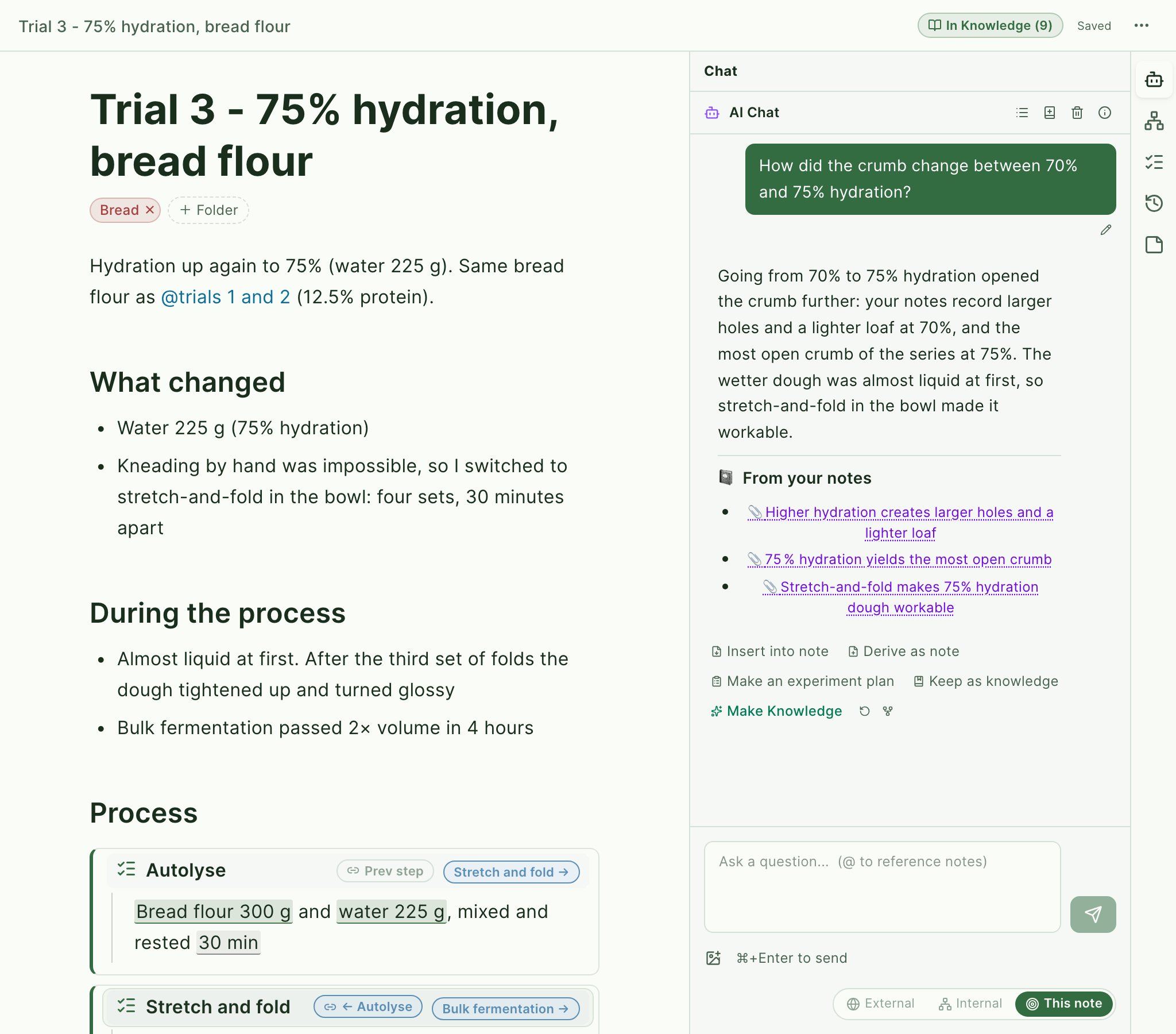
Every AI reply has action buttons underneath:
| Button | What it does |
|---|---|
| Insert into note | Inserts the answer into the note as blocks |
| Replace in note | Replaces the source blocks with the answer (shown when the chat was started from specific blocks) |
| Derive as note | Creates a new note from the question and answer, with provenance linking back to the source note, and opens it in the side peek |
| Make an experiment plan | Turns the next experiment the answer proposes into a plan note with a table of conditions, and one run note per row (below) |
| Make Knowledge | Extracts knowledge candidates from the answer (below) |
| Keep as knowledge | Saves the whole answer as-is, as a Q&A page in the Knowledge layer (below) |
Extracting knowledge from a chat Added in v0.16.8 (2026-07-02)
Make Knowledge turns a good answer into entries in your Knowledge layer — without saving anything you didn't choose. Graphium shows "Extracting claims…", then "Generating insights…", and presents a picker titled Knowledge candidates (select to save). Each candidate carries a Claims or Insights badge; use Select all / Clear, then Save selected (n) — or Cancel to keep nothing. Only the candidates you pick become knowledge pages.
Keeping a whole Q&A
If the answer already reads well as a self-contained explanation — not something to break into separate claims — press Keep as knowledge instead. Graphium calls the AI once more first, handing over the conversation so far to rewrite the exchange into a Q&A page that reads standalone — filling in what a context-dependent reply left implicit and rewriting the title away from the phrasing of your request — with any citation the answer showed carried over to the rewritten sentences. There's no preview to edit first; if the rewrite fails or strips out every citation the original had, Graphium falls back to saving the message text unedited, titled with the question you asked. Once saved, the button becomes a confirmation with an Open link to the new page, and from then on the page is upkept like a Topic — revised when a source updates or contradicts the answer, checked, and source-checked. See Knowledge layer for details.
Making an experiment plan from an answer Added in v0.122.0 (2026-11-06)
Once you have asked the AI what to try next after reading the procedures of the papers you brought in, the answer can become the plan. Press Make an experiment plan under the answer and Graphium makes two kinds of notes and opens the plan note.
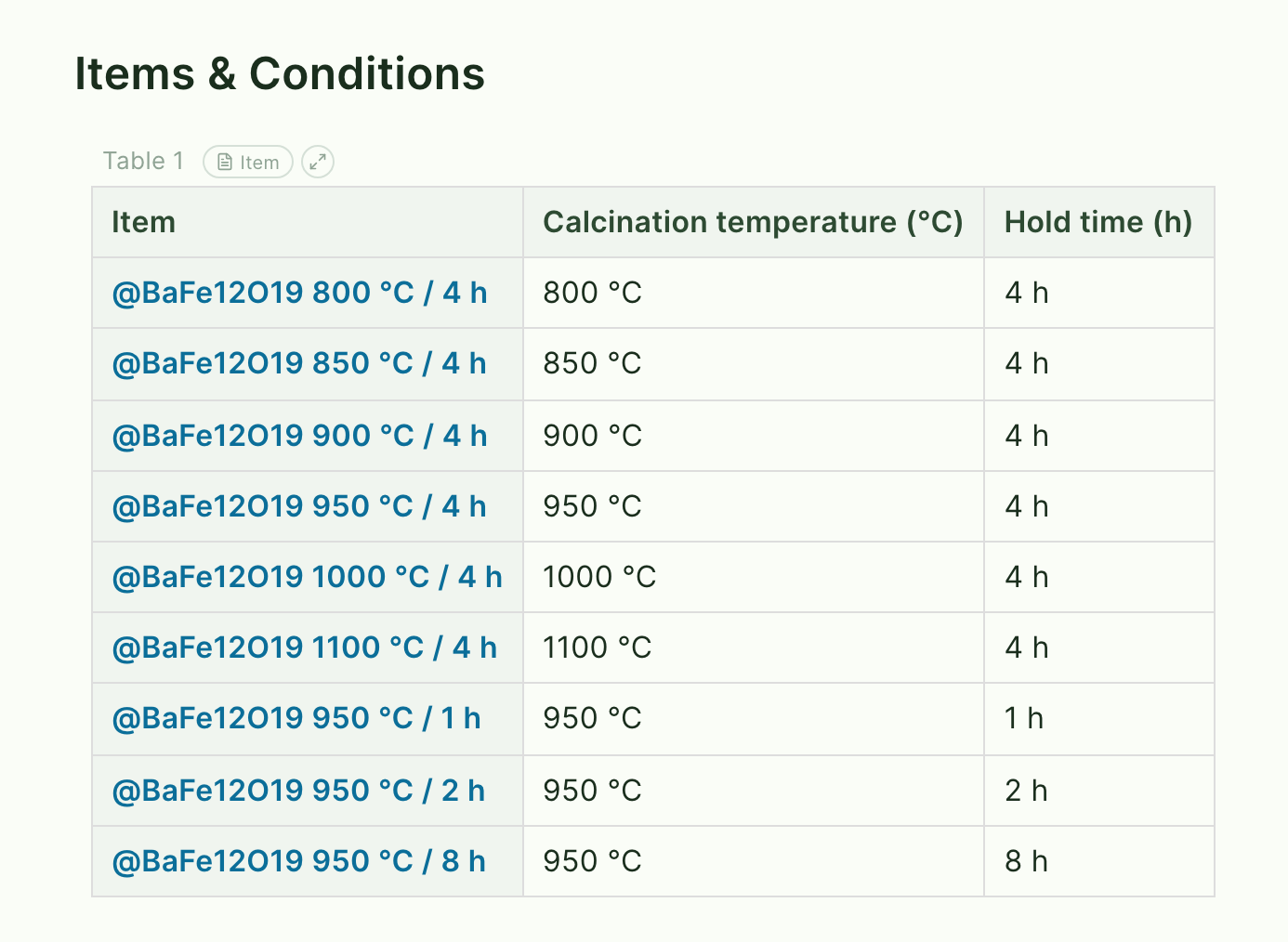
- A plan note (in the Plan folder) with background, a Items & Conditions table, the common procedure and the expected outcome. Each row of the table is one sample, and the columns after the first are the parameters you vary (for example the substitution x and the calcination temperature). Notes the answer cited are linked with @ under the background.
- One run note per row holding the common procedure with that row's values. Steps, materials, tools and conditions are highlighted from the start, and the first column of the table links to it. They also appear in the plan note's Operations tab.

The procedure goes through the same extraction and name alignment as Extract steps into a note does for papers, so names it can tell are the same line up with your paper notes. In the provenance graph, the materials and instruments of the papers connect to the run notes.
TIP
Turn on Research before answering (above) and ask something like "compare the procedures of these papers and suggest which conditions to vary next". The AI follows the procedures in your paper notes before it answers. Then press Make an experiment plan.
This usually calls the AI four times: to build the plan, to extract the procedure, to align names, and to check where the plan comes from (below; a retry after broken output can add one). When the answer gives only a range, values are chosen evenly inside it. The values are the AI's proposal: check and edit them in the table before you run the experiment.
Where this plan comes from Added in v0.123.2 (2026-11-06)
Whether a plan is a good idea is for you to judge, but you can see what it rests on. After the notes are made, the AI compares each condition, material, instrument and step of the plan with the notes the answer cited and the chat answer, and adds a Where this plan comes from section at the end of the plan note.
The section opens with what was compared and the conclusion, one sentence each ("Nothing differs from them, and every item is written in at least one of them." or "Items to check before you run the experiment: N."). The items follow in these groups; a group with nothing in it is left out.
| Group | What it holds |
|---|---|
| Differs from a note or the chat answer | A note or the answer gives a different value or choice for the same thing (for example 950 °C in the paper but 1500 °C in the plan). The note and its value are shown |
| Not written anywhere: filled in by AI while building the plan | In neither the notes nor the answer |
| Not in the notes: newly decided in the chat answer | New ideas land here; this is not an error |
| Written in the notes it builds on | Grouped by note with an @ link, items underneath. The link opens the paper's note |
Check the first two before you run the experiment. If the check fails, the plan is left as it is. How well it catches mistakes is recorded in Checking where a plan comes from.
The Composer (⌘K / Ctrl+K)
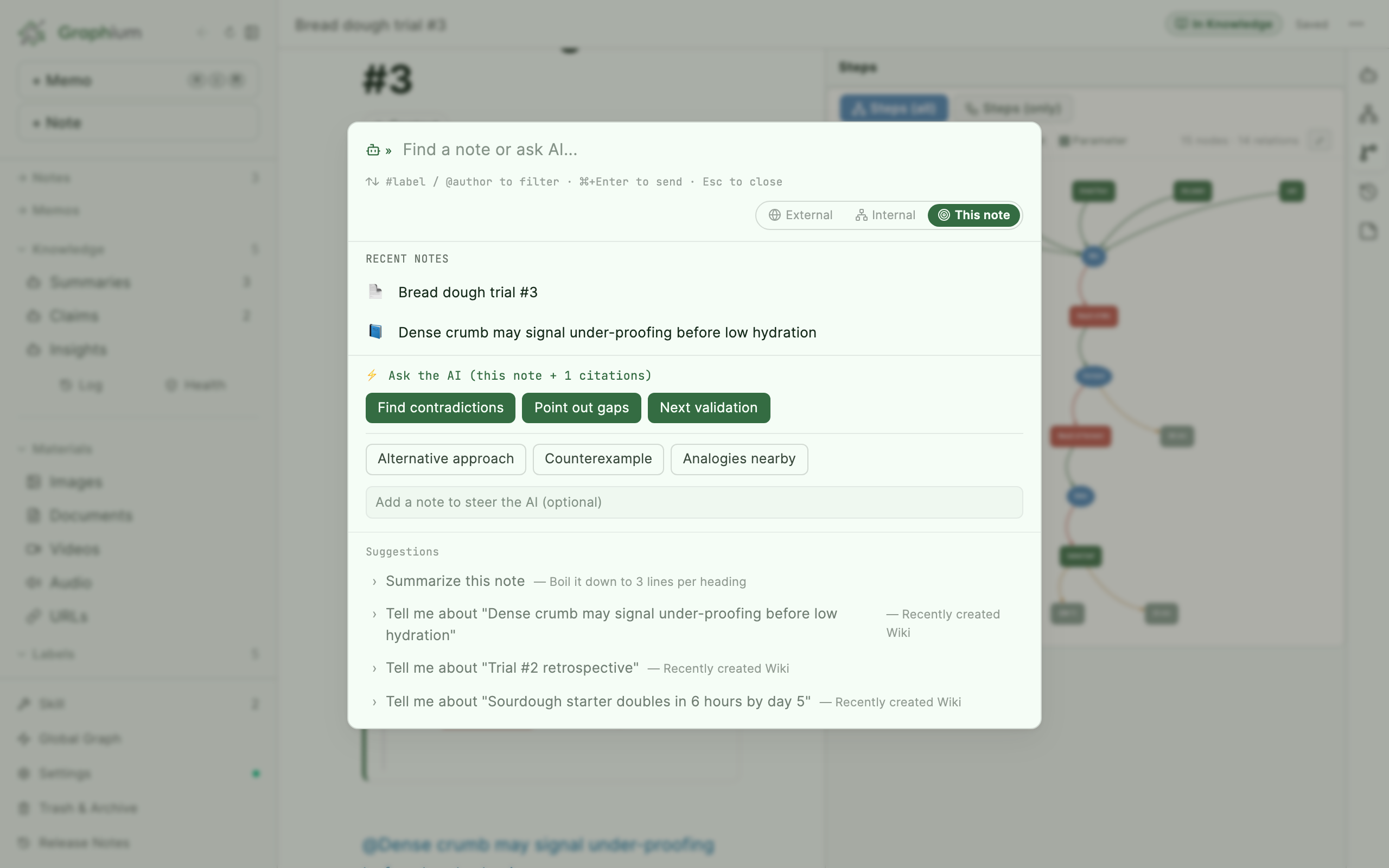
Press ⌘K (Ctrl+K on Windows/Linux) to open the Composer — one input for both "find a note" and "ask the AI". The AI half needs a registered AI model; the search half does not. Esc closes it. The Search button at the top of the left nav opens the same Composer.
The placeholder says it all: Find a note or ask AI...
Both halves are live everywhere — not only while editing a note. Open ⌘K from the note list, the materials gallery, the Knowledge hub, or with nothing open at all, and you can still search and ask the AI a fresh question. The verb buttons and one-click suggestion cards described below are the exception: they need a note open that cites claims or insights, since their prompts are built from that note's cited set. The search-only form still appears when no AI model is registered at all Added in v0.39.0 (2026-08-17) — the search half needs no AI, so ⌘K still opens.
Finding notes
As you type, matching notes appear instantly, searched by title, headings, labels, and author — and by the words in the note body, through the same on-device full-text index the AI chat uses Added in v0.39.0 (2026-08-17). A body match shows an excerpt around the matched words under the title, so you can tell why a note is listed before opening it. Title and heading matches rank above body-only matches. Two filter tokens narrow the list, as the footer hints ("#label / @author to filter"):
| Token | Filters by |
|---|---|
#label | Notes containing that label |
@author | Notes by that author |
Your own notes and the AI's Knowledge pages (Topics, Claims, Summaries, and so on) are listed separately, under Notes and Knowledge, so a busy Knowledge layer never pushes your own notes off the list. Added in v0.98.1 (2026-10-27) Each section shows its top matches — 8 notes, 5 Knowledge pages, 4 memos, 4 shared entries, 4 assets — and ends with Show N more when there are more; choose it (with the mouse, or ↑/↓ and Enter) to expand that section in place, up to 50; if there are still more, a line under it suggests adding words to narrow the search. With an empty input you get Recent notes and Recent Knowledge. Press Enter to open the highlighted note.
Enter — opens it in the side peek next to the note you are writing, so you can look at two notes side by side without linking them. If a peek is already open, its note is replaced. Nothing is recorded as a link, so the provenance graph is unchanged. To move to the note instead, use Open full screen, the button at the right end of the row, or press ⇧Enter (Shift+Enter). The row of the note you are editing, and every row when no note is being edited (the notes list, for example), still open full screen.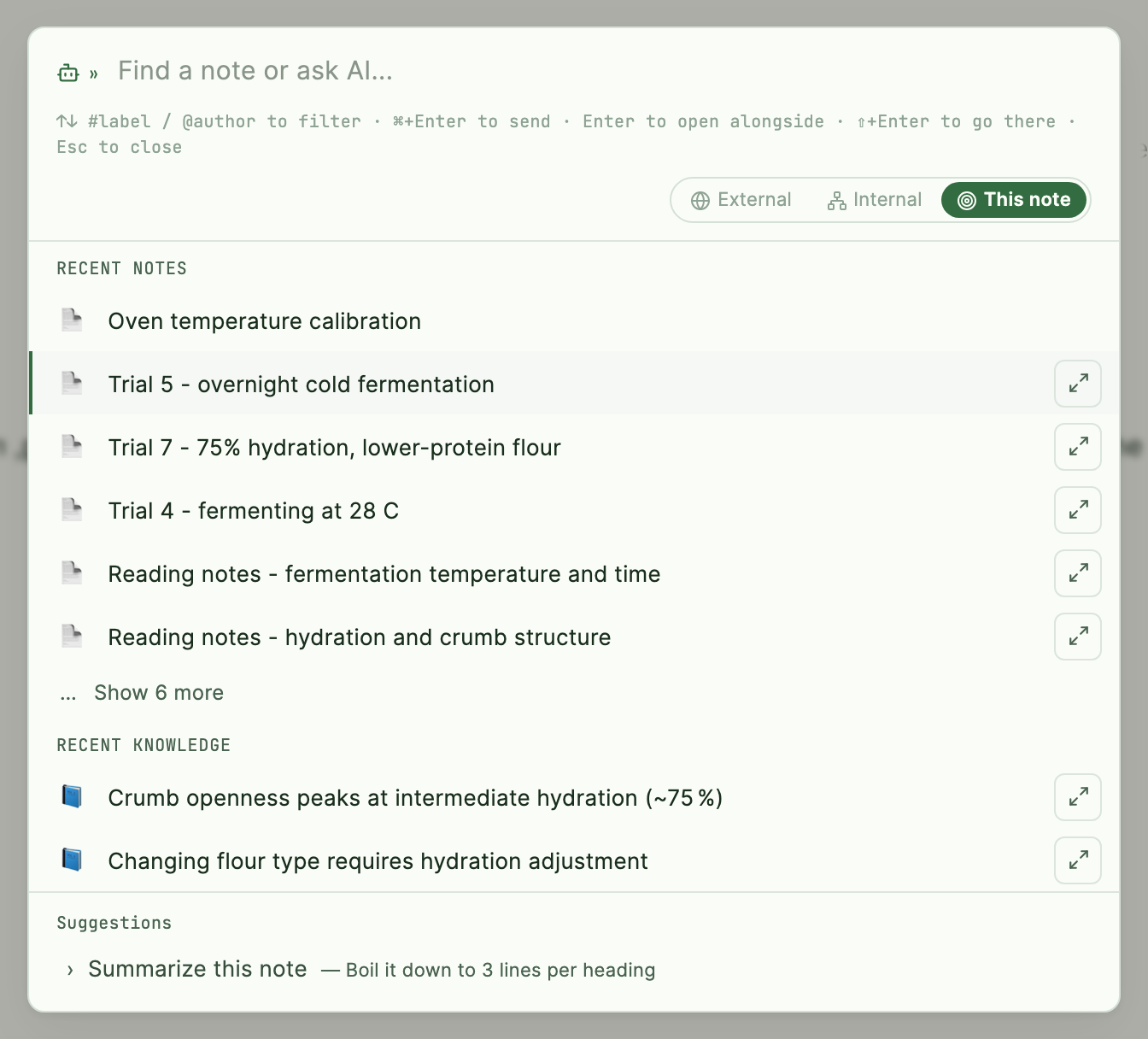
Finding memos Added in v0.129.5 (2026-11-10)
Memos are searched too, and listed under Memos, between Knowledge and shared entries. A memo matches when every word you type appears somewhere in its text — in any order, even across line breaks — or when its folder name matches. A memo containing your words exactly as typed ranks above one where they are scattered. Memos have no title, so each row shows a line of the memo itself, starting a little before the first match, with the matched words highlighted.
Selecting one opens the memo in the same peek you get from a memo source elsewhere: next to the note while you are editing one, or in the list's side peek otherwise. Memos you have archived or moved to the trash are not listed. Memos already inserted into a note are still listed, since the memo itself is still in your memo list.
Like assets, memos stay out of the empty-input view and out of #label / @author queries.
Finding assets Added in v0.35.0 (2026-08-13)
Assets are searched alongside the notes and listed under Assets. Images you have read with OCR match on their file name and on the words read out of them; PDFs, URLs, and documents match on their name and on their text (the text of a PDF or Word file, the slides of a PowerPoint file, the excerpt and description of a URL) through the same full-text index Added in v0.39.0 (2026-08-17). Each row carries a thumbnail — or a type icon for non-images — and an excerpt around the match, so two similar screenshots, or two papers, are told apart before you open either.
Selecting one opens the materials gallery on that asset's tab, with the asset in the side peek — rather than jumping to a note. Added in v0.102.0 (2026-10-29) While you are editing a note, it opens in the side peek next to the note instead — the same peek you get by clicking an @ mention of the asset — and Open in materials gallery, the button at the right end of the row, or ⇧Enter (Shift+Enter) takes you to the gallery. One asset can be used by several notes, or by none, and the peek lists the notes that use it.
Assets stay out of the empty-input view and out of #label / @author queries; both of those are about finding notes.
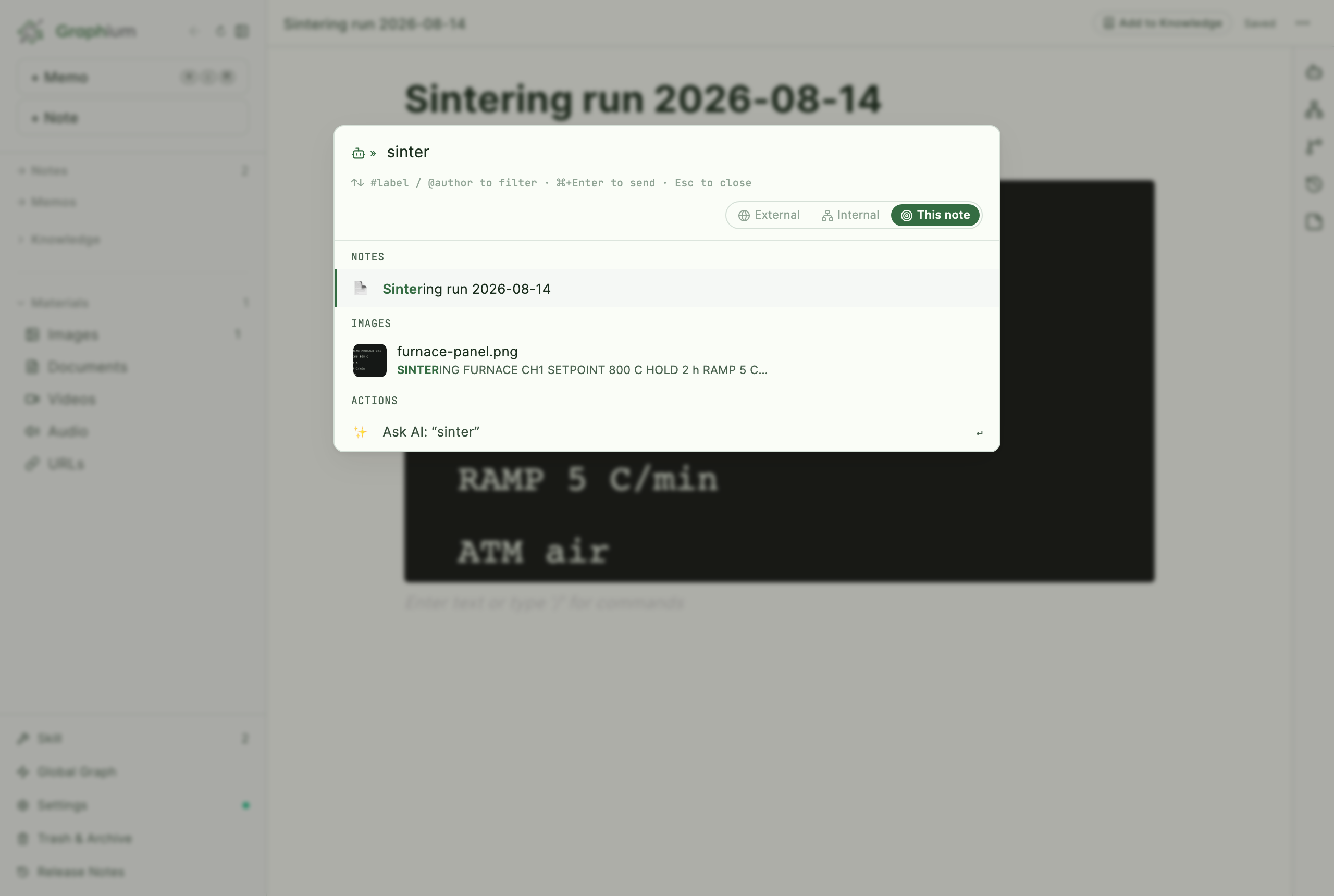
Asking the AI
The last row of results is always Ask AI: "your text" — select it, or press ⌘Enter to send your input straight to the AI regardless of what is highlighted. The answer opens full-screen, as a new conversation of its own — not the open note's chat panel, even if you had a note open when you asked. If a note was open, it is attached above the conversation as a citation chip, which you can remove with its ×; while attached, its content is handed to the AI as context. The Composer has the same Grounding chip and web-search warning as the chat panel.
Verb buttons on notes with citations
On a note that cites claims or insights, opening the Composer with an empty input shows a set of one-click questions about the cited set, under the heading Ask the AI (this note + N citations). Unlike a typed question, these go straight to the open note's chat panel (the same one in the right-hand panel), because their prompts are built from that note's own cited claims and insights:
| Group | Buttons |
|---|---|
| Examine the cited set | Find contradictions · Point out gaps · Next validation |
| Broaden the direction | Alternative approach · Counterexample · Analogies nearby |
An optional text field ("Add a note to steer the AI (optional)") lets you add one line of guidance; clicking a verb fires immediately. These are the questions that get sharper as your citation set grows — a single LLM prompt can't check your claims against each other, but this can.
Skills: saved prompt templates
A skill is a reusable instruction document — for example a writing-voice guide or a domain glossary — that Graphium can apply automatically. Open Skill in the bottom section of the left nav, under the tabs (it sits in the same place in every tab, and appears once an AI model is registered), to see them. Graphium ships with built-in system skills, which cannot be deleted but can be edited and restored with Reset to default.
Each skill's Edit dialog controls:
| Setting | Effect |
|---|---|
| Description | Shown as a label in the list ("not sent to the AI — the AI reads the prompt body") |
| Language | All languages / Japanese / English — "Applied only when the generation language matches." |
| Auto-apply on Ingest | When on, the skill's prompt is automatically appended as instructions when Graphium generates knowledge from your notes — and in AI chat conversations |
Skills are ordinary documents: click one to edit its prompt body like any note.
The built-in Knowledge Schema is the exception to auto-apply: Graphium always supplies its saved body as a separate instruction when an assistant helps with Knowledge, or when Topics, Answers, and Claims are generated. The first saved default follows the UI language at creation time and does not change when you later switch the UI. To replace it deliberately, open the Schema and use the confirmed Switch to Japanese or Switch to English action; the previous body stays recoverable in History. It defines structure, citations, revision, and upkeep rather than writing voice; it can be edited and reset like a system skill, but cannot be deleted. Added in v0.81.1 (2026-09-18)